
The Chronicle – A Living History
Shrimp and Grits: A Culinary Inevitability
The criers, the cooks, and the cultural convergence that made a Lowcountry classic.
The Shrimp & Grits Standard About 43 minutes to read
Shrimp and grits began as a Lowcountry breakfast long before it reached a dinner menu. This history follows it through Indigenous corn, the tidal creeks, the shrimp criers of Charleston and Savannah, the cooks whose names reached print, and the restaurants that carried it far from home. It marks what we know and what we are guessing, and every claim leads to a numbered source. Check the work in the research appendix.
The Lowcountry made shrimp and grits.
At five o’clock on the morning of June 21, 1881, a shouting man walked up Meeting Street in Charleston, South Carolina, and ruined everybody’s sleep. The next day, the News and Courier reported what he sang:
Raw raw swimmy
Got sugar een do horn
Why don’t you come and buy
Dese leetle raw raw prawn,1
— The News and Courier, Charleston, June 22, 1881
The citizen writing to the paper complained the refrain “brought people out of their beds like the horrors of a nightmare.” Then it reported the part that matters. While the sleepers showered “left-handed blessings” on the vendor, the “bon vivants hastily rang for the cook to buy a plate of shrimps for breakfast.” The man was called a fiend. His customers bought shrimp from him anyway.1
Seven years later, a Charleston paper described the same bargain:
If there is one thing that can compensate the average Charlestonian for being robbed of his morning nap by the insatiable and conscienceless raw shrimp fiend it is the reflection when he is startled from his slumbers that at any rate he will have a breakfast of hominy and shrimps […]2
— The Sunday News, Charleston, April 8, 1888
Notice what both writers took for granted. Neither explained what shrimp for breakfast was, why anyone would want it, or who came up with the idea. By 1881, Charleston already knew. The Lowcountry had long known.
This is the story of a place and of the people who worked it.
For this story, the Lowcountry is the tidewater world of Charleston, Beaufort, Savannah, the Sea Islands, and the towns and creeks in between. Charleston and Savannah sit some eighty miles apart as the crow flies, with Beaufort and the Sea Islands strung between them. From Savannah further south to Brunswick, Georgia, is about seventy more.3 Follow the water, not the county lines: tidal creeks into the marsh, rivers past old rice fields, boats toward a city market. The wider Gullah Geechee cultural region runs farther still, along the southeastern coast.4
That coast supplied shrimp in quantity. Corn supplied the staple. Indigenous people built the maize foodways. Africans and their descendants brought knowledge, adapted it, and did much of the fishing, vending, and cooking. Enslavement and dispossession shaped every one of those encounters. Later, freedom, wages, commerce, cookbooks, and restaurants reshaped them again.54
Shrimp and grits came out of that world. Asking who invented it is a little like asking who invented the conversation at the dinner table.
The food that became grits was here before America was.
Long before there was a United States, or an English Carolina, Indigenous Americans cultivated maize and knew how to make it keep, travel, nourish, and taste good. Parching (dry roasting), pounding, grinding, soaking, and cooking were a varied repertoire of survival skills.5
In 1682, Thomas Ashe watched one piece of that repertoire in Carolina and recorded it:
The Indians in Carolina parch the ripe Corn, then pound it to a Powder, putting it in a Leathern Bag: When they use it, they take a little quantity of the Powder in the Palms of their Hands, mixing it with Water, and sup it off: with this they will travel several days.6
— Thomas Ashe, Carolina, 1682
Roast it. Pound it. Carry it. Add water when you need it.
That’s instant grits, y’all.
Parching had already cooked the corn, so a handful of powder and a little water was ready to eat. A portable meal, made with practiced skill, already waiting for a European visitor to notice.
John Lawson, traveling the Carolinas around 1700, put a name to a version of it in his 1709 book:
Rockahomine Meal, which is their Maiz, parch’d and pounded into Powder7
— John Lawson, A New Voyage to Carolina, 1709
Elsewhere he described the women who did the work: four at a time, beating corn with long pestles in a narrow wooden mortar, each keeping her stroke so exactly that, in his words, “’tis worthy of Admiration.” He was an outsider, and he saw an expertise that belonged to the people doing the work.7
Other Indigenous preparations used wood-ash lye to loosen the hull and transform the grain. Historian Rachel Briggs treats hominy as a whole Eastern Woodlands foodway, with many foods and processes inside it. Its full range runs well beyond what any early visitor recorded.5
That leather bag of parched corn can sit out of the modern argument over the definition of grits. Ashe described what people did, and Lawson described what people ate. The lineage runs through the crop, the knowledge, and the repeated transformation of hard corn into everyday food. Both passages are about corn, and both belong at the beginning of the story.
First, a word about the words.
Jack Leland, a Charleston writer, had feelings about the vocabulary. In 1978, describing his own breakfast, he wrote of
hominy, which barbarians now call grits or hominy-grits, depending on the extent of their ignorance8
— Jack Leland, Evening Post, Charleston, July 22, 1978
The man was at war over breakfast, and he was not alone. Charleston and Savannah spent two centuries using grits, grist, and hominy in ways the modern dictionary does not. A search for today’s name alone can walk straight past the meal.9
The words came by different routes. Grits descends from Old English grytt, coarse meal. Grist comes from the same family: grain for the mill. Hominy is the outsider: an Algonquian word, generally identified as Powhatan, first recorded in English in 1629. The English words are old. What they meant in the Lowcountry has its own history.9
Savannah’s Harriet Ross Colquitt settled the matter in The Savannah Cook Book in 1933, in nine economical words:
It’s grist before it is cooked, and hominy afterwards.10
— Harriet Ross Colquitt, The Savannah Cook Book, 1933
Forty-three years later, Elizabeth Hamilton’s new foreword to the 1976 edition of 200 Years of Charleston Cooking said the same thing from the other direction:
One buys grits, cooks it and the result is hominy.11
— Elizabeth Hamilton, foreword to 200 Years of Charleston Cooking, 1976 edition
So in the old Lowcountry kitchen, the word depended on the stage of the corn. Raw was grist, or grits. Cooked was hominy. That is the opposite of how a modern reference book draws the line, which is by process, lye or no lye.
Here is the usable chronology. These are located examples, each a dated sighting of a word in use.
| Where and when | What the record says |
|---|---|
| Charleston area, June 1786 | An estate-sale ad lists a “Stone Grits Mill.” The raw product already had the name.12 |
| Charleston, 1847 | The Carolina Housewife uses both spellings: “grist” for the “hommony” recipe and “grits” for grits bread.13 |
| Georgia, June 1847 | The Southern Banner explains “Homony” as a cracked-corn breakfast porridge.14 |
| Charleston, 1888 and 1930 | A newspaper names “hominy and shrimps.” A cookbook prints “Shrimps with Hominy.”215 |
| Savannah, 1929 and 1933 | A recollection names fried shrimp and hominy. Colquitt defines grist and hominy.1610 |
| Charleston, 1957 | A newspaper feature calls “hominy grits” a heresy to old-timers, and cites dictionaries to settle the argument.17 |
| Charleston, September 12, 1961 | The earliest located newspaper use of the exact phrase shrimp and grits.18 |
| Wider print | The 1888 breakfast story reprints in newspapers in Iowa and California under the older wording, “hominy and shrimps.” The 1985 national profile prints “Shrimp With Cheese Grits.”1920 |
The shrimp were already here. The harvest became a meeting of worlds.
The shell rings and middens of the southeastern coast preserve thousands of years of Indigenous shellfish gathering. Lawson, too, lists shellfish among Indigenous foods. That establishes a deep coastal seafood history, long before any written recipe.227
And shrimp are invisible in those middens because of biology.
The shrimp belonged to a productive estuary. Young shrimp move into tidal creeks and marsh habitat, and knowing how tide, season, and moon move them is part of knowing how to catch them.25
For the biological reasons above, the pre-Columbian record is silent on shrimp harvesting in the Lowcountry. The written record picks up from there: African knowledge of boating and fishing shaped how these waters were worked. The South Carolina State Library’s collection on Lowcountry fish and shrimp nets states that enslaved Africans taken to the Lowcountry, later known as Gullah people, brought skills in boating and fishing, and that net-making is a skilled art form rooted in Africa.26 Gullah Geechee culture formed among the descendants of enslaved Africans in this coastal world and carried African inheritances through language, food, religion, craft, and community life.4
Put the pieces together and the origin comes into focus. Indigenous corn, English milling words, and African-descended fishing and cooking skills met in European-descended households, in cities whose laws and economies, from the colonial era until emancipation, were built on slavery, specifically the enslavement of the very people who held those skills. Black fishers, vendors, and cooks did much of the documented work of catching, selling, and cooking this food, and they brought real skill to it.
Shrimp and grits is where those traditions converge, and that convergence is its origin.27
The creeks became highways.
The first time the record catches a Charleston netmaker in the act, it is 1784. The Revolution is barely over. The advertisement is on the front page of the South-Carolina Gazette:
FISHING SEANS, of all sizes, to be made, and mended, by the Subscriber; Shrimp, Cast, and other Nets, at as cheap a rate as they can be made or mended with strong work.28
— Mathew Jousseaum, “The Corner of Queen and Union-streets, near the Fish-market,” South-Carolina Gazette, April 6, 1784
A “Shrimp” net and a “Cast” net, offered by name, at the corner of Queen and Union Streets, steps from the Fish Market. That is the earliest located Charleston print evidence of a cast net, and the earliest located South Carolina print mention of shrimp as something people caught and sold. It reflects the coverage of one newspaper corpus; shrimp were surely caught long before the spring of 1784.28
Who did the fishing? Charleston’s city badge system answers part of it. An 1812 copper badge in the Charleston Museum reads “No. 72 Fisher.” The museum says it “would have been worn by an enslaved person hired out to catch and sell fish.”29 Enslaved men and women were among the people catching and selling Charleston’s seafood, and the city licensed them to do it.
That brings us to the people who did the selling, and to the oldest complaint in the city.
By the time the record finally lets us overhear the shrimp trade, the trade had spent generations learning to survive the city that depended on it.
The Civil War brought freedom. The foodway endured.
On November 7, 1861, a U.S. Navy fleet steamed into Port Royal Sound, took the Sea Islands, and made Beaufort a Union headquarters.47 Planters fled to the mainland. About ten thousand enslaved people stayed on land they had worked their whole lives.48 In 1862, teachers including Laura Towne began the Penn School on St. Helena Island.49 On January 1, 1863, thousands gathered at Camp Saxton, near Beaufort, to hear the Emancipation Proclamation read.48
Some of the war’s turning points happened on the water. On the night of May 12 into May 13, 1862, Robert Smalls, born enslaved in Beaufort, took the Confederate steamer Planter out of Charleston Harbor past Fort Sumter and delivered her, and sixteen people, to the Union fleet.50
In January 1865, General Sherman’s Special Field Orders No. 15 set aside roughly 400,000 acres of coastal land for Black families. President Andrew Johnson overturned it in the fall of 1865 and returned most of that land to the planters.51 A promise, made and unmade in one year.
The war ended slavery, and the slaveholding economy built on it. The knowledge carried by the people who had worked these waters outlasted both, and much of it found a larger market. Butler writes that “the real ‘golden age’ of local huckstering dawned after the Civil War, when scores of formerly-enslaved people expanded this popular and convenient form of marketing,” because, in his words, “the end of slavery severed traditional ties of racial co-dependence and forced many people to scramble to find new sources of income.”52
Fishing and shrimping became foundations for Black communities up and down the coast. At Pin Point, outside Savannah, a Georgia Historical Society marker records that the community “was settled in 1896 by former slaves from Ossabaw, Green, and Skidaway Islands,” and was “the site of several coastal industries including: shrimping, crabbing, and oyster harvesting operations.” Ben Bond and John Anderson Seafood opened there in 1900; A.S. Varn and Sons ran from 1926 to 1985.53 At Harris Neck, in McIntosh County, Georgia, Black families fished, crabbed, oystered, and shrimped until the federal government condemned their land for a military airbase in 1942.54 Hoskins-Brown’s study of Georgia’s coastal fisheries follows skills practiced under slavery into family livelihoods after it.55
Freedom and isolation, together, let Gullah Geechee culture flourish. The National Park Service ties the retention of African traditions to the isolation of coastal plantations and Sea Islands, and notes that bridges did not reach the islands until the twentieth century. Hilton Head’s first bridge opened in the mid-1950s.56 A St. Helena net maker, Luke Smalls, described how simply it had been done:
In those days, the only way you could get a net was to sew one.57
— Luke Smalls, St. Helena Island, Coastal Heritage, Spring 2000
Limits were severe. Land, capital, and political power stayed out of reach for most. Even so, people kept fishing, selling, and cooking, and the city kept buying.
Fresh shrimp came with a voice.
By 1873, the record describes the night shift in close, vivid detail. A long feature in the News and Courier on August 14 took a day in the life of the city’s street cries and began, naturally, at dawn:
The fishermen who are engaged in taking shrimp are a thrifty set of night workers. Their sole possession in the way of stock in trade consists of a “dug-out” canoe and a cast-net. They start out on the last of the ebb or flood tide, and follow the “run” of the shrimp up either bank of the river which may happen to be the leeward bank. The shrimp generally resort to the marsh shores to feed, and it is here that they are taken. One man paddles the canoe and another casts the net.46
— “The Street Cries of Charleston,” The News and Courier, August 14, 1873
About four hours’ work filled the boat. By daybreak the fishermen were landing at Moreland’s wharf, on South Bay, where the hawkers waited in a crowd. The reporter said the scene would “put Billingsgate Market to shame.” London’s fish market was a byword for foul language, and he made the charge explicit: “Fishwomen all over the world are notorious for their excessive profanity,” and in Charleston he heard “cursing, swearing, haggling and pushing.” The insult was aimed at the crowd’s manners, even as the piece admired its hustle. Within a half hour, in his words, “the air is made musical with the cry of ‘Raw Shrimp,’” sung in every pitch “from the shrill tenor of the young African of ten summers, to the bass profundo of the patriarch of fifty years.”46 Many of the vendors were women. Every one of them was selling breakfast.
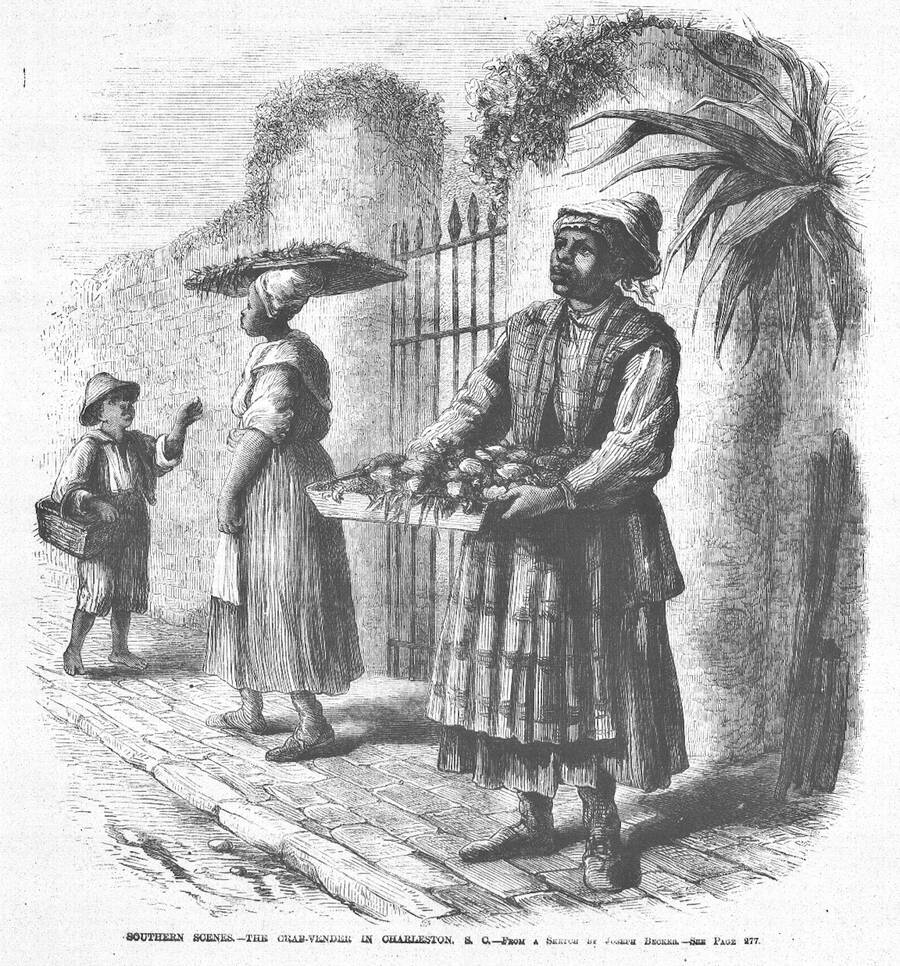
Eight years later, in June 1881, came the morning that opened this chronicle. The 1881 writer treated the vendor as a known local figure, “that peculiar institution,” he called it, “which is to be found probably nowhere outside of Charleston—the shrimp fiend.” His “first appearance” was the season’s first, and the piece is the earliest located record of a trade that began long before. He reported the price too. “At present the fiend asks 60 cents for a plate of the crustaceans.”1 A plate was already the unit of sale. The vendor’s own language, and his customers’, was settled enough to print without explanation.
Then names begin to appear. On March 29, 1885, the Sunday News reported that “Joe Cole, drummer and fishmonger, appeared yesterday for the first time this season in the role of a raw shrimp fiend,” with Florida shrimp at forty cents a plate.58 Joe Cole became the city’s best-known voice. On November 4, 1887, the News and Courier caught him mid-performance:
Raw, raw swimmy, got shugger een he hawn. I say, Mr. Reporter, way is we now?58
— Joe Cole, quoted in The News and Courier, November 4, 1887, which called him “one of the loudest and most musical shrimp and pawgee [porgy] fiends in the city”
He sold porgy and shrimp, and he did it with a wife. By October 1890 he was “The Fish and Shrimp Dealer, Joe Cole,” traveling to Summerville with his wife to celebrate their twenty-eighth wedding anniversary with “all their relations, and children and grandchildren.”58 On January 2, 1900, at a banquet of the Gridiron Club at the Charleston Hotel, a comic had just finished imitating a shrimp vendor when
Joe Cole, the real shrimp fiend, ambled in the door. Cole had on his regulation shrimp uniform, and his cries were the same old cries that have been heard thousands of times in the early morn.58
— The News and Courier, January 2, 1900
The Evening Post added that he carried his tray on his head, “just as though he was on the streets,” and that the guests were eating “shrimp in the Charleston way” as he did it.58 A few years later, in February 1903, a man arrested for stealing a pie gave the police Cole’s name. Cole ran a notice to clear it: “I am the original Joe Cole, the fish man, of the firm of Joe Cole and Wife. I appeared before the Gridiron Club at a banquet at the Charleston Hotel in 1901 and showed them Washington newspaper men how to sell shrimp.”58
In 1910, Harriette Kershaw Leiding described him on lower King Street under “the quaint sign of ‘Joe Cole & Wife’”: “Joe has many imitators but no equals, for he looks like an Indian Chief, walks with a limp that would ‘do a general proud,’ and uses his walking stick as a baton, while bellowing like the ‘Bull of Bashan.’”59 Butler gives Cole’s dates as 1840 to 1919, and says that hawking porgy was “a stepping stone from slavery to freedom.”60
The vendors’ songs were the ads. In the 200 Years of Charleston Cooking of 1930, Kate Hagood Tobin listened and wrote down the words of the shrimp man’s song:
Oh, lady, if yo’ want to tas’e somethin’ sweet,
Jes’ take a li’l onion an’ a li’l piece o’ meat
An’ mix ’em wid yo’ tender, pure, raw s’rimp.61
— The shrimp man’s song, as transcribed by Mrs. Kate Hagood Tobin, 200 Years of Charleston Cooking, 1930
The pitch included a recipe. Onion. Meat. Shrimp.
Savannah had its own chorus. Colquitt printed it in 1933 and the vendors, she wrote, came in from the neighboring watering places with baskets on their heads:
Crab by’er! Yeh Swimps! Yeh Oshta!10
— Savannah’s street vendors, as printed in The Savannah Cook Book, 1933
The city fathers had tried over and over to end the peddling, she added, and failed, because “the plea of the housewife has carried the day.”10 Some things never change. The neighbors complained, the cooks kept buying, and the vendors kept selling.
Joe Cole has a name in print. Nearly everyone else who sang this song reaches us as a tray, a basket, a voice, or a cook. The names are gone. The work is everywhere in the story.
Shrimp and grits was breakfast because the clock was ticking.
Let’s put the pieces together. Shrimp were caught at night. Vendors waited at the wharf before dawn. The cry went out at first light. Hominy already belonged to breakfast. The meal begins to explain itself.6214
Fresh seafood spoils fast, and the Lowcountry is HOT. Before dependable household refrigeration, the fastest way to keep a morning’s catch was to get it into a pan that morning. A Sunday News letter of April 8, 1888, makes the point in an unappetizing way: the shrimp the writer bought at six o’clock were spoiled and rank, and the household cook was not even up yet.2 The city had an appetite and a clock, and the clock was winning.
Ice was a slow revolution in the South, and it arrived in stages. The earliest Charleston ice house the research located opened in 1797.63 By May 21, 1829, the proprietors of an ice house on Meeting Street were advertising in the Courier that they had “this year imported five large cargoes of ICE” and would sell it at a cent a pound.64
“Breakfast shrimp” sounds quaint until you picture the delivery. Then lunch sounds like pushing your luck.
This is an interpretation of a documented routine. Ice, money, and taste all shaped the dish, and cold storage was one factor among them. The early sources describe urban households eating the breakfast regularly.
What they do describe is a family around a table. In July 1894, a Sunday News writer sketched it:
as the pater familias doles out the regulation amount for each plate of hominy the eyes of the children glisten and the death-like stillness that ensues bears witness to their love for their breakfast.62
— “A Song of ‘Raw Swimps,’” The Sunday News, Charleston, July 22, 1894
That article estimated some three hundred vendors, men and women, working the city, and said that “there is hardly a family in the city that does not have this dainty little crustacean served for breakfast in some shape or form.” Those are the newspaper’s own words, and the picture they paint is clear.62 The shrimp were boiled, peeled while steaming, and peppered, then set on a long dish. Without pomp or presentation. A family too busy eating to talk.
Hominy and Shrimps for Breakfast
On April 8, 1888, the Sunday News ran an article headed “Rather Give Up the Shrimp.” It opened with the line quoted near the start of this Chronicle, and kept going:
If there is one thing that can compensate the average Charlestonian for being robbed of his morning nap by the insatiable and conscienceless raw shrimp fiend it is the reflection when he is startled from his slumbers that at any rate he will have a breakfast of hominy and shrimps, and that even Vanderbilt and his $10,000 cook are in that one particular poorer than any man in Charleston. For neither Mr Vanderbilt nor his $10,000 artist can get up a shrimp breakfast (“as she is cooked” in Charleston) at the frozen North. It is admitted that there are no shrimps in America at least, that can compare with the Charleston shrimp in delicacy of flavor or in tenderness of flesh. There are prawns and shrimps elsewhere perhaps, but the little Charleston shrimp is as far ahead of them as Hyperion to a Satyr, and one of his principal peculiarities is the fact that he will not submit to be carried away from home. He generally puts in an appearance about this time of the year and he stays with us all the summer. He never consents to be sent away from home.2
— The Sunday News, Charleston, April 8, 1888
Read the full 1888 article
RATHER GIVE UP THE SHRIMP.
A Southern Dish that Vanderbilt’s Dug-nol Can’t Cook—The Beaufort Shrimp.
If there is one thing that can compensate the average Charlestonian for being robbed of his morning nap by the insatiable and conscienceless raw shrimp fiend it is the reflection when he is startled from his slumbers that at any rate he will have a breakfast of hominy and shrimps, and that even Vanderbilt and his $10,000 cook are in that one particular poorer than any man in Charleston. For neither Mr Vanderbilt nor his $10,000 artist can get up a shrimp breakfast (“as she is cooked” in Charleston) at the frozen North. It is admitted that there are no shrimps in America at least, that can compare with the Charleston shrimp in delicacy of flavor or in tenderness of flesh. There are prawns and shrimps elsewhere perhaps, but the little Charleston shrimp is as far ahead of them as Hyperion to a Satyr, and one of his principal peculiarities is the fact that he will not submit to be carried away from home. He generally puts in an appearance about this time of the year and he stays with us all the summer. He never consents to be sent away from home.
All this, however, is written merely by way of introduction. An indignant subscriber writes to The Sunday News to call attention to a gigantic fraud which is being perpetrated upon this long suffering community by the raw shrimp fiend.
“I am fond of shrimps,” he writes, “and as much as I hate to be disturbed by the diabolical yells of the shrimp fiend, I am willing to put up with the annoyance because shrimps are good things to have about the house, that is, in moderation. At 6 o’clock this morning I heard the familiar cry, ‘Raw, raw sprawn,’ and bye and bye I caught the refrain, ‘Sugar een he hawn.’ Of course, my cook hadn’t turned over yet. Cooks, somehow, seem to be proof against early morning street cries. A desire came over me to have some shrimp for breakfast, and jumping up I ran to the window, threw it up and yelled at the shrimp fiend to come over. Almost before I had finished my shout I fainted away by the effluvia that emanated from that tray of ‘prawn.’ It poisoned the atmosphere and was sufficient to create an epidemic. It remained with us for ten minutes after the man had turned the corner at the next block.
“Now, anybody who knows anything about Charleston shrimps need not be told that it is impossible for a Charleston shrimp to become loud, unless, perhaps, he has been kept over night. So I took the trouble to look into the matter and I found that the ‘prawns’ in question had come from Beaufort, which accounts for the effluvia. I want to say this: It seems to me that the police might take this matter up. If a fishmonger is caught selling decayed fish the fish is confiscated and destroyed. I hope the police will keep an eye on these Beaufort shrimps and send them back to their native waters.”
It is true that Beaufort shrimps have been offered for sale on the streets of Charleston, and it is also true that a tray full of Beaufort shrimps, a day old, contains almost enough effluvia to contaminate several blocks.
About the Vanderbilt joke. The subheading’s “Dug-nol” is Joseph Dugnol, the French chef William K. Vanderbilt imported in March 1888 on a five-year contract at $10,000 a year. Newspapers across the country ran the story in the second half of that month, because importing a cook under contract was said to break the federal contract-labor law. When Charleston’s paper joked about “Vanderbilt and his $10,000 cook,” readers knew exactly who was meant, and the joke was less than three weeks old. The point of it is that all that money could not buy a Charleston shrimp breakfast.65
The paper expected its readers to recognize the meal. The breakfast was the reward for being so rudely woken daily by the cries of the vendor. The two sides of that bargain came up again and again. A letter to the Sunday News in July 1896, signed “Insomnia,” grumbled about the cry but allowed that it was “sweet to the ear of the housekeeper” when a shrimp breakfast had been decided on.66 By then the city had passed an ordinance, on September 11, 1888, forbidding any huckster from crying “fish, shrimp, vegetables or other commodities” before six in the morning or after nine at night, with an extra hour allowed on Saturday nights.37 In August 1911, the Evening Post reported “the usual complaint of the crying of shrimps,” noting that “the ordinances forbid the crying of the vendors before 6 o’clock in the morning, but the law is frequently violated.”67
The story traveled too. Reprints carried the Charleston breakfast to readers in Iowa and California in 1888, trimmed to the first paragraph and retitled “Hominy and Shrimps for Breakfast” or, in Bridgeport, California, “The Charleston Delicacy,” so the coast wasn’t keeping a perfect secret.19
Not everything was about the morning noise. On July 8, 1916, a reader of the Evening Post signing himself “Shrimp Fiend” wrote in to complain about something else entirely:
Is there a trust on shrimp by which we are compelled to buy Florida prawn shipped here on ice at 25 cents a plate, in place of our juicy little fresh shrimp at 10 cents a plate alive!68
— “Shrimp Fiend,” letter to the editor, Charleston Evening Post, July 8, 1916
By 1916, the word fiend had become a badge customers wore proudly, and iced out-of-state shrimp was already competing with the local catch, nine years before trawlers reached Beaufort.6869
Georgia’s evidence has its own dates. In 1929, the Savannah writer William Garrard recalled fried shrimp and hominy at Isle of Hope in 1914. It is a memory published fifteen years after the fact. In January 1917, a Ladies Aid Society supper announcement in Brunswick listed shrimp and hominy among its offerings, which shows shrimp and hominy sharing a menu.1670
Then history finally gives us names.
Cookbooks give names more readily than newspapers give cooks. Unfortunately, the name on the cover was not always the name at the stove.
200 Years of Charleston Cooking, published in 1930, makes the arrangement unusually visible. Blanche S. Rhett, wife of R. Goodwyn Rhett, gathered the recipes. He was mayor of Charleston from 1903 to 1911 and the son of Albert Moore Rhett, a pioneer in Charleston’s phosphate-fertilizer industry. Lettie Gay, director of the Home Institute of the New York Herald Tribune, edited the book, testing and organizing what Rhett had collected. Helen Woodward, whom the Jewish Women’s Archive calls “generally believed to be the first female account executive in the United States” and the author of Through Many Windows (1926), who spent the winter of 1929–30 as Mrs. Rhett’s tenant at the Pirate House, wrote its introduction and explanatory matter. The book was her idea. Within that arrangement, the book names Black cooks whose work fills its pages.157172
Sally Washington enters this story for one reason: history needs to remember her name.
Here is how Woodward introduces her, in the headnote to an okra pilau:
My cook in Charleston was called Washington. Her full name was Sally Washington, but naturally no one ever called her Sally.73
— Helen Woodward, 200 Years of Charleston Cooking, 1930
That “naturally” does a great deal of social work. A writer explains another woman’s name through the household relationship between them.
Here is what the record says. Washington was Woodward’s cook during Woodward’s Charleston stay. The recipes credited to her are an okra pilau, red rice, chicken dressing, sweet-potato pie, and prune cake. The Charleston paper’s cookbook series printed her full name in a recipe credit on November 29, 1930. Her birth date, life story, and obituary are still to be found.73
So she stays here in a supporting role, and a real one in Southern cooking lore. In a record that so often calls a working woman “the cook,” a surviving full name is something to keep. Sally Washington cooked. People wrote some of her work down. We can remember her name.
William Deas was the chef behind the first printed recipe.
In the same 1930 book, the recipe for “Shrimps with Hominy” ends with a two-word credit:
— William’s Recipe15
The book identifies William elsewhere as William Deas, the Rhett family’s butler and an accomplished cook. That makes him the named source of the earliest printed shrimp-and-hominy recipe located in this research. It is a precise and substantial credit that stands on its own.71
The recipe is on the page in the book’s own voice:
This is a delicious breakfast dish, served in almost every house in Charleston during the shrimp season.
[…]Shell the shrimp, put them into a saucepan in which the butter has been melted, add the seasonings and stir until the shrimp are hot. They may then be covered, stirred occasionally, and allowed to cook for ten minutes. Serve with the hot hominy.15
— “Shrimps with Hominy,” 200 Years of Charleston Cooking, 1930, pp. 20–21
A pound of raw shrimp. Half a cup of butter. Salt and black pepper. Two cups of cooked hominy. Four servings.15
Then comes an anecdote about an unnamed seventy-eight-year-old:
A charming old gentleman seventy-eight years old avers that as far back as he could remember he has eaten shrimp with hominy for breakfast every morning during the shrimp season, and shrimp salad for supper every Sunday night, and he has never tired of it.15
The diner is an unnamed man, more than forty years older than Deas. The anecdote tells us how the book wanted readers to see the dish: habitual, seasonal, and already old.
For Deas himself the book offers something firmer. In Woodward’s account of the project:
When we started this book of Charleston cooking we first had a talk with William. A stenographer took down his instructions.71
— Helen Woodward, 200 Years of Charleston Cooking, 1930
Let’s stop here a moment. They began by asking the cook.
His knowledge passed through transcription, editing, and publication, but the credit remained his. Still, this is far better than a recipe drifting into print with its source erased.
William Randall Deas was born on December 25, 1896. He served in the Army in the First World War. In the 1930 census he was thirty-three, a butler in private service, and head of his own rented household, with a wife and children.74 The professional the cookbook admires was a man with a life beyond his employer’s dining room, in a segregated city.
He later became a restaurant chef. His 1961 obituaries describe more than twenty years at the restaurant known as Everett’s, a reputation for she-crab soup, and a restaurant that closed during his funeral.75 Everett’s had also named a dining room for him, the William Deas Room, in 1956, five years before he died.76 The restaurant honored him in his lifetime and again at his death. That is a working life worth attention in its own right: a Black professional cook whose reputation held in segregated Charleston.
An Everett’s advertisement in November 1965, four years after Deas’s death, offers “Charleston River Shrimp (Sauteed in Butter), Hominy Grits, Butter, Toast and Jelly” for $1.65. That is the breakfast his recipe describes, still on the menu at the restaurant where he had cooked for more than twenty years.77
The record already gives him a great deal: his name credited on the earliest located printed shrimp-and-hominy recipe, his profession, and evidence of the regard in which his work was held. All of that stands proudly and prominently in history.
The catch changed scale. Breakfast changed its timetable.
The meaningful shift in the twentieth century is that the relationship among a catch, a customer, and a meal changed.
Commercial trawling arrived beside the older small-boat trades. In 1925, a fleet of Florida-based trawlers reached Beaufort County, South Carolina, and started the area’s first commercial trawl-based shrimp industry, icing the catch and shipping it north by refrigerated rail. South Carolina was slow to build a fleet of its own, with only five registered shrimp boats in 1934.69 The Charleston Museum identifies storms and the pull of larger, refrigerated commercial boats among the reasons the Mosquito Fleet eventually faded.44
Meanwhile, the street trade became something the city celebrated. From 1934 to 1953, Charleston’s Azalea Festival crowned a “Champion Huckster of Charleston,” with categories that included “best shrimp or fish huckster,” and dressed the contestants in “authentic” costumes before a panel of white judges.52 In July 1937, a fish huckster named John Wilson recorded his street cries into a portable machine for the Society for the Preservation of Spirituals, so that “traditional Carolina sounds” could be handed down to future generations.78 When a city begins recording its cries for posterity, it generally suspects they are fading.
Newspaper food pages show the same shift from the other end. In August 1951, the Evening Post’s food page ran “Shrimp Leads Shell-Fish In Popularity,” a general column for readers well beyond Charleston. It recycled the elderly diner from the 1930 cookbook, still “now 78” twenty-one years later, and then moved on: “When we can’t get fresh shrimp, there are frozen and canned shrimp, so we can experiment with recipes for them the country over and the year round.” The breakfast had become an anecdote, and shrimp a product that no longer needed a morning catch. In May 1952, Chlotilde R. Martin, writing from Beaufort as a special correspondent for the News and Courier, noted that “Not for some years” had anyone heard the morning cry, “Swimp, swimp, here yo’ swimp goin’ by.” She remembered when “we used to have shrimp and hominy and even fish and hominy for breakfast,” supposed that “people had more time and different appetites,” and doubted she could manage such a breakfast anymore.79
These are glimpses of household life, and they matter. A dish tied to a morning catch could become a memory, a prepared product, or a restaurant order. The food could persist while the daily system around it changed.
In 1950, Charleston Receipts printed a breakfast shrimp gravy.
In November 1950, the Junior League of Charleston published Charleston Receipts. The shrimp section treated shrimp with hominy as an established coastal breakfast. A community cookbook was helping a household tradition travel from one kitchen to another.80
The shrimp chapter says that the very small shrimp of the Carolina Low-Country’s creeks and inlets “cannot be purchased from the markets but from the negro hucksters who cry their wares through the old city’s streets: ‘Swimpee, raw, raw swimp!’” Over the page, under the heading “Shrimp for Breakfast,” the book says the rest plainly:
Shrimp prepared in various ways have long been a breakfast favorite in the coastal region, and they are always served with hominy.80
— Charleston Receipts, 1950, “Shrimp for Breakfast,” p. 49
The paragraph goes on. “Many of the following receipts have been handed down for generations,” it says, and “the simplest and easiest way of serving breakfast shrimp is to sauté them in melted butter and serve hot,” which is the same plain method as the 1930 recipe. The chapter’s epigraph, in dialect, makes the same point in a line about a household’s fish and shrimp, “’e hab hominy en’ ting.”80
Two of the receipts show how much variety already fit inside the breakfast. Breakfast Shrimp, credited to Mrs. Ben Scott Whaley (identified as Emily Fishburne), builds a gravy from bacon grease, onion, green pepper, Worcestershire, catsup, and flour, and ends with the instruction “Serve with hominy.” Beaufort Stewed Shrimp, credited to Mrs. Stuart Dawson (identified as May Elliott Hutson), goes another way: boiled shrimp simmered with butter and vinegar and served “hot or cold for breakfast with hominy.” The book holds different answers to the same morning question.80
A developed shrimp gravy is on the record decades before Crook’s Corner and Claiborne’s 1985 profile took the dish national. Home cooking had been busy.
And then the trail goes strangely quiet.
The 1960s and 1970s survive in scattered traces of home kitchens, and in even fewer of Black home kitchens. A thin archive covers plates that were full.
The finds that do survive are useful. On September 12, 1961, Norman E. Spell Jr. wrote in his Charleston column of creek shrimp he had cast-netted himself, “sauted slowly in butter and served with grits,” the earliest located newspaper use of the phrase shrimp and grits.18 Everett’s was still advertising its breakfast in 1965. The Charleston Inn’s Little Grill advertised the dish in December 1970, and an October 1971 feature named Robert Geddies Jr.’s Lowcountry shrimp and grits among the specialties at the Holiday Inn Riverview.7782
A few of the old voices still turn up. In October 1965, a film crew shot a scene on Church Street for a television production set in Charleston’s Catfish Row, and the Evening Post reported that they filmed “the shrimp man” as he “sang his wares in a delightful ‘dressed-up’ version of his everyday song.”83 The latest located sighting of a working shrimp man is a man performing for a camera.
Then, in 1978, Jack Leland, who sneered at the “barbarians” who “now call [hominy] grits,” described his own breakfast: extra-sharp cheese stirred into the hominy, with the Charleston Receipts Breakfast Shrimp on top. Cheese grits under shrimp gravy, in a Charleston home, seven years before Claiborne’s 1985 profile of Bill Neal.8
These fragments establish continuity, restaurant service, changing vocabulary, and variation, all printed in local newspapers.
Bill Neal put it on the menu. Craig Claiborne told the country.
Bill Neal was a young, self-taught chef cooking Southern cuisine when few restaurants did. He was from near Gaffney, South Carolina, and had spent time in Charleston. At Crook’s Corner in Chapel Hill, North Carolina, about 225 miles as the crow flies from the Lowcountry, he put shrimp and grits on the dinner menu. His published 1985 version combined cheese grits, shrimp, bacon, mushrooms, scallions, garlic, lemon, hot sauce, and parsley, with the shrimp done in a quick sauté.843
Neal’s real contribution was taking the dish beyond the Lowcountry. The pairing, its name, restaurant service, cheese in the hominy, and a shrimp gravy were all on the Charleston record before Neal. What he supplied was a chef’s touch and a dinner-menu slot for an old coastal breakfast, in a restaurant far from the tidal creeks.
The timing was perfect. On July 10, 1985, the New York Times published Craig Claiborne’s profile, “For a Carolina Chef, Helpings of History,” with a recipe titled “Shrimp With Cheese Grits.” A regional preparation now had a recipe and a story in a newspaper with a national audience.20
The breakfast had been news before. This was a different kind of visibility: a named chef, a recognizable restaurant version, and instructions anyone could follow at home. Neal’s place in this story is as one of the early cooks of the Southern revival, standing where a national critic happened to be looking. That deserves credit.
The name is much younger than the meal.
Google Books has scanned millions of printed books and can count how often any phrase appears in them, year by year. The chart below tracks “shrimp and grits” in English-language books from 1950 to 2019.

The phrase is nearly absent from books through the 1980s. It reaches about one occurrence per billion three-word phrases by 1995, about ten by 2005, and about twenty-three by 2019. The climb that follows the 1985 profile is gradual, and it unfolds across three decades.85
The chart measures when the name went public in print. The meal itself is far older. Everything earlier in this story, the street cries, the restaurant ads, and the cookbook receipts, shows people eating shrimp with hominy long before the phrase “shrimp and grits” was common in books.
Once the dish went national, cooks made it their own.
Once a restaurant dish is recognizable, cooks have something to riff on. More pork. More sauce. Different corn. A different shape for the grits. Sometimes a beautiful idea. And sometimes it becomes unrecognizable.
Magnolias, which opened in Charleston in 1990, belongs to the rise of upscale Southern cooking. A recipe credited to chef Donald Barickman pairs shrimp and sausage with tasso gravy over creamy white grits, and a recent restaurant menu lists the same combination. Cream, stock, smoked pork, and a substantial sauce take the plate far from Deas’s shrimp and butter.86
The Southern food revival that Neal belonged to kept growing. Before Husk opened in 2010, Sean Brock described a restaurant built around Southern ingredients and the recovery of older dishes and crops. His place in this story is that turn toward regional ingredients and agricultural memory.87
The grits themselves can change jobs. At Page’s Okra Grill in Mount Pleasant, South Carolina, Eater reported in 2025, the dish comes with fried grit cakes and andouille cream sauce. Soft breakfast porridge becomes a crisp foundation.88 Frying cold, cooked hominy is an old and pennywise Southern kitchen use for leftovers; The Carolina Housewife gave Charleston cooks cakes made from it in 1847. The restaurant version is new, and the technique is older than anyone’s menu.1389
And then there is the cook who knew the value of leaving it alone. Bill Smith became chef at Crook’s Corner in 1993, when the dish was already a fixture. He told Eater in 2014:
I would never dream of changing it.90
— Bill Smith, Eater, April 4, 2014
Smith matters as a witness to the dish’s durability. Neal’s version was inherited, and Smith kept it nearly as he found it. Around it, other kitchens kept changing the dish.
Everybody in this story helped make shrimp and grits.
Indigenous people supplied the maize foundation and the knowledge of turning it into food. Africans and their descendants made the coastal food economy work, under slavery and after emancipation. Gullah Geechee communities carried and developed foodways through family and working life. Fishers caught the shrimp. Vendors like Joe Cole got them to the door. Cooks turned provisions into breakfast.5455
Print preserved some of that work and hid some of it. William Deas received a recipe credit we can follow. Sally Washington’s full name survives with five recipes, from okra pilau to prune cake, in a record that usually calls a working woman “the cook.” Families, churches, and Junior League compilers recorded preparations that might otherwise be lost. Neal put a chef’s version on a dinner menu, Claiborne enlarged its audience, and Smith kept that version recognizable. Other cooks went in different directions.157380842090
This is a continuum, with unequal power, uneven credit, and circumstances that were often unfair. Putting the people back into it makes the dish more interesting.
Shrimp and grits was a culinary inevitability.
The corn was there. The shrimp were there. So were the cooks who knew how to turn grain into a meal and bring a catch from tidal water to a kitchen, and the households with appetites, seasons, and mouths to feed. Sooner or later, the corn and the shrimp were going to meet in the same bowl.
By 1881, a man could shout shrimp up Meeting Street at five in the morning, and every listener already knew the breakfast.
A Lowcountry Creation.
What does the future hold?
After centuries of people changing this dish, it would be a peculiar moment to declare it complete.
What happens when artificial intelligence gets a seat at the table?
The Standard’s recipe experiment asks a practical question: if we compare the historical record, the recipe family tree, and modern versions, what would an ideal shrimp and grits look like? Our first AI-built proposal brings together stone-ground corn, shrimp-shell stock, a restrained bacon gravy, mushrooms, and a little sharp cheddar. It is a proposal to cook and judge, a modern voice in a long conversation.92
Read: The Standard’s “Ultimate” AI-Built Shrimp & Grits Recipe →
The story isn’t finished. This is living history.
Notes and sources
“Earliest located” describes this research’s findings; archives not yet searched may hold earlier items. Historical spelling is retained in quotations; typography is normalized. Printed dialect is a writer’s transcription. Distances are approximate straight-line figures between city centers. Several quotations from secondary web sources were checked through page summaries and are marked as such. Newspaper items cited as GenealogyBank are subscription page images. The research appendix gives the full text of the key newspaper items, where to read the sources free, the searches behind the findings, and a plain list of what we know and what we are guessing. On fried grits: the earliest located attestations are the ones cited, and other early American mush recipes, including Mary Randolph’s The Virginia House-wife (1824), have not yet been read in full. The 1855 Eatonton item is cited for its phrase alone. The 1929 and later recollections are testimony. Last updated October 7, 2026. AI assisted with research organization, drafting, and presentation.
Footnotes
-
“The Advent of the Shrimp Fiend,” The News and Courier (Charleston), June 22, 1881, 1. GenealogyBank page image; full text in the research appendix. The vendor’s first appearance is dated by the article itself to “yesterday morning,” June 21, at five o’clock. The vendor is unnamed. “Fiend” is used in its period sense of a pest or a zealot. ↩ ↩2 ↩3
-
“Rather Give Up the Shrimp,” The Sunday News (Charleston), April 8, 1888, 2. GenealogyBank page image; transcribed beside the clipping above. The famous first paragraph is an introduction to a subscriber’s complaint about spoiled Beaufort shrimp. Its boasts about Charleston shrimp are not scientific claims. ↩ ↩2 ↩3 ↩4
-
Approximate straight-line distances between city-center coordinates, computed for this Chronicle by the haversine formula: Charleston to Savannah about 83 miles; Savannah to Brunswick about 69; Charleston to Beaufort about 49; Beaufort to Savannah about 35; Charleston to Chapel Hill about 222, rounded to 225 in the text. Road mileage is longer and is not claimed. ↩ ↩2
-
National Park Service, Low Country Gullah Culture Special Resource Study (2005), and Gullah Geechee Cultural Heritage Corridor Management Plan, chapter 2 (2012). See also NPS, “Gullah Geechee Culture”. These establish regional and cultural context, not an inventor or an exclusive transmission route. A named Black cook is not automatically identified as Gullah Geechee. ↩ ↩2 ↩3 ↩4
-
Rachel V. Briggs, “The Hominy Foodway of the Historic Native Eastern Woodlands,” Native South 8 (2015): 112–146; Thomas Ashe and John Lawson, cited separately. These establish Indigenous maize foundations and varied processing, not a documented shrimp pairing. ↩ ↩2 ↩3 ↩4
-
Thomas Ashe, Carolina; or, A Description of the Present State of That Country (1682), reprinted in Alexander S. Salley Jr., ed., Narratives of Early Carolina, 1650–1708 (1911), 146. Line wrapping removed. ↩
-
John Lawson, A New Voyage to Carolina (1709), sections on Indigenous food and beating corn. The “Rockahomine” passage sits in Lawson’s general catalog of Carolina Indian foods and is not tied to a particular place on his route, so it is cited as a general Carolina practice rather than a coastal one. Original text consulted, not a modern excerpt that glosses the word as “grits.” ↩ ↩2 ↩3
-
Jack Leland, “Ambrosian Breakfasting In The Holy City,” July 22, 1978, 3-A. Byline: Evening Post staff writer; indexed under News and Courier in GenealogyBank. GenealogyBank page image. The passage also describes extra-sharp cheese stirred into the hominy and the cookbook’s Breakfast Shrimp preparation. ↩ ↩2
-
Douglas Harper, Online Etymology Dictionary, entries “grits”, “grist”, and “hominy”. The 1629 date is an English-language attestation, not the age of the Indigenous word or the food. David S. Shields (personal communication, September 22, 2026, quoted with permission) describes Charleston’s “grist” and “grits” as related by metathesis; standard dictionaries treat them as parallel descendants of one root. ↩ ↩2
-
Harriet Ross Colquitt, ed., The Savannah Cook Book (1933), author’s note, xv–xviii, 33–35, 41, 73–76. Grist quotation, p. 75; vendor cry, p. 33; the housewife’s plea, p. 34; breakfast and supper serving instruction, p. 35; fried and baked hominy, p. 76. ↩ ↩2 ↩3 ↩4 ↩5 ↩6
-
Elizabeth Hamilton, foreword to Two Hundred Years of Charleston Cooking (Columbia: University of South Carolina Press, 1976), xi. The title page and library catalog records credit “a new foreword by Elizabeth Hamilton.” The phrase is the foreword’s own, and the 1930 edition and Charleston Receipts (1950) do not use “grits.” ↩
-
Robert Murrel Jr. estate-sale advertisement, Christ Church Parish, June 1786, listing a “small Canoe, Stone Grits Mill.” Sale advertisement for Thursday, June 8, 1786; clipping provided by David S. Shields, with the full text in the research appendix. The clipping carries no masthead. The Charleston Morning Post, June 2, 1786, is the best identification so far and remains to be confirmed against the newspaper. ↩
-
Sarah Rutledge, The Carolina Housewife (Charleston, 1847), read in the 1979 University of South Carolina Press facsimile with Anna Wells Rutledge’s introduction: hommony receipt, p. 94 (starts from “grist”); “Grits Bread,” p. 22 (“fine, washed, raw grits”); breads and cakes from cold hommony, pp. 13–27. The hommony receipt uses sieving and an ash soak, not lye by name. ↩ ↩2 ↩3
-
“Homony,” Southern Banner (Athens, Georgia), June 8, 1847, 4, page record. The page’s machine-read text is damaged in places, so The Chronicle paraphrases the preparation instead of quoting it. ↩ ↩2
-
Blanche S. Rhett, compiler; Lettie Gay, editor; Helen Woodward, introduction and explanatory matter, 200 Years of Charleston Cooking (New York: Jonathan Cape and Harrison Smith, 1930), 20–21, recipe and credit crossing the page break. Page numbers are the first edition’s; a revised edition appeared in 1934, and the 1976 University of South Carolina Press edition is a photographic reprint. The News and Courier printed the recipe again on November 8, 1930, page 9. The 1930 edition also prints hominy fritters. ↩ ↩2 ↩3 ↩4 ↩5 ↩6 ↩7 ↩8
-
William Garrard, review of Ward Greene’s Cora Potts, The Savannah Press, December 7, 1929, 7; indexed as Savannah Evening Press. The recalled meal is dated 1914; the testimony is dated 1929. Closing paragraph in the research appendix. ↩ ↩2
-
“Fast Disappearing Water Wheels Once Turned Grist Mills In State,” “Do You Know Your South Carolina?” feature, The News and Courier, October 7, 1957, 8. Unsigned. It treats “grits,” “hominy,” and “hominy grits” as near-synonyms for the cooked dish while citing dictionaries that distinguish them, and notes that “old-timers” consider “hominy grits” a heresy. ↩
-
Norman E. Spell Jr., “Necessity Makes For Good Eating,” “Spellbound,” News and Courier, September 12, 1961, 1-B. GenealogyBank page image. This is the earliest located newspaper appearance of the exact phrase; the research makes no claim it is the earliest use anywhere. ↩ ↩2
-
“Hominy and Shrimps for Breakfast,” Audubon County Republican, May 10, 1888, 5; “The Charleston Delicacy,” Bridgeport Chronicle-Union, December 15, 1888, facsimile. Reprints of the Charleston paragraph, not independent witnesses to meals in those states. ↩ ↩2
-
Craig Claiborne, “For a Carolina Chef, Helpings of History”, The New York Times, July 10, 1985. The article prints a recipe titled “Shrimp With Cheese Grits.” The Times page sits behind a subscription wall, and the attribution to Claiborne follows secondary accounts, such as the University of North Carolina Graduate School’s page on Crook’s Corner, which says “Craig Claiborne’s rave review in the New York Times made it the restaurant’s most-ordered entrée.” ↩ ↩2 ↩3
-
Independent Press (Eatonton, Georgia), January 20, 1855, Georgia Historic Newspapers, “some fried homony.” Cited for the phrase alone. ↩
-
National Park Service, “Experimental Archaeology: Were Archaic Shell Rings Prehistoric Water Tanks?”. Supports shellfish gathering, not a corn-and-shrimp pairing. ↩
-
Florida Museum, “Fishing Net Fragments,” 100 Years @ Florida Museum, on palm-fiber net fragments from Key Marco, Collier County, recovered by Frank Hamilton Cushing in 1896; the museum attributes preservation to anaerobic muck. Key Marco is a Gulf-coast Florida analogy, not a Carolina or Georgia find. ↩
-
Published studies of Georgia coast shell rings and middens, such as “Marine trophic levels targeted between AD 300 and 1500 on the Georgia coast” (University of Georgia, abstract record), report mollusks and fish and, in the studies we checked, no shrimp or other crustaceans. The preservation argument is our own reading of two public sources: experiments on how quickly shrimp decay and leave no fossil trace, in Open Palaeontology, and the Florida Museum’s account of Key Marco net fragments surviving only in oxygen-free muck (see the Key Marco note). Shrimp are expected to be missing from the digs, so their absence says nothing either way about whether people ate them. ↩
-
South Carolina Department of Natural Resources, State of South Carolina’s Coastal Resources: Penaeid Shrimp (2004), 1–2. Used for ecology, not current fishing regulations. ↩
-
South Carolina Digital Library, “Lowcountry Fish and Shrimp Nets”, collection note; see also University of Georgia Marine Extension, Cast Net Workshop, on cast-net making as a Gullah Geechee heritage craft on Sapelo Island. These establish a tradition and its cultural framing, not an exclusive transmission route. ↩
-
This paragraph is the Chronicle’s synthesis, not a finding in any single source. Its parts are documented in the notes for Indigenous maize foodways (Briggs, Ashe, Lawson), the English word history (etymology and the 1786 mill advertisement), African-descended fishing and cooking skill (the State Library nets note, the National Park Service Gullah Geechee studies, the 1812 “Fisher” badge, and the Deas recipe credit), and the legal and economic setting (the sidebars on Charleston’s huckster laws and Savannah’s ordinances, and the notes on Carolina’s 1669 founding law and Georgia’s 1735–1755 slave laws). “European-descended households” describes the employers, cookbook compilers, and buyers named in the sources; it does not say no other households existed. ↩
-
Mathew Jousseaum advertisement, The South-Carolina Gazette, and General Advertiser (Charleston), April 6, 1784, 1; also April 8 and 17, 1784. GenealogyBank page image. A broader search (“shrimp,” “prawn,” “swimp”) found nothing earlier in South Carolina coverage. Full text in the research appendix. Whether “shrimp” and “cast” nets were different gear is unresolved. ↩ ↩2
-
Charleston Museum, slave badge, object MG 208, “No. 72 Fisher,” 1812, silversmith John J. Lafar; Harlan Greene, “Slave Badges,” South Carolina Encyclopedia, on the badge system (1783–1865). ↩
-
Nic Butler, “Hucksters’ Paradise: Mobile Food in Urban Charleston, Part 1,” Charleston County Public Library, Charleston Time Machine, May 15, 2020. Butler cites primary sources, including The Statutes at Large of South Carolina and the Journal of the Commons House of Assembly, which this research has not independently checked. The reading of the 1736 and 1751 measures as aimed at Black vendors is an inference from wording and timing, not a quoted statement of legislative intent. ↩ ↩2
-
“The Fundamental Constitutions of Carolina,” March 1, 1669, article 110, Avalon Project, Yale Law School; quotation verified directly. The Avalon text is dated March 1, 1669. Faye Jensen, “July, 1669: First Draft of the Fundamental Constitutions of Carolina is Completed,” South Carolina Historical Society, July 7, 2021: first draft in Locke’s handwriting, likely the combined work of the eight Lords Proprietors, drafted in England and shipped to Port Royal in the fall of 1669. The article number is cited as Butler and the Avalon text give it. Nic Butler, “Carolina’s Bajan Roots, Part 2,” Charleston County Public Library, Charleston Time Machine, December 1, 2017, on Barbadian planters, slavery before settlement, and the 1707 arrivals; quotations verified directly. ↩
-
Act No. 294, “An Act to appoint and erect a market in Charles Town, for the publick sale of provisions, and against regrators, forestallers and ingrossers,” ratified April 8, 1710, as cited in Butler, Part 1. Butler cites the title in The Statutes at Large of South Carolina, vol. 2, p. 351, and the text in the South Carolina Department of Archives and History’s Nicholas Trott manuscript, “Laws of South Carolina,” pp. 31–38. The quoted phrases are Butler’s quotations of the act. ↩ ↩2
-
South Carolina Gazette, March 23–30, 1734, for the grand jury’s presentment, as cited in Butler, Part 1. Butler cites later complaints in the Journal of the Commons House of Assembly, September 10, 1746–June 13, 1747 (Easterby and Green, eds., 1958), p. 154 (February 5, 1746/7); the South Carolina Gazette, April 18, 1771 (supplement); and the South Carolina Gazette and Country Journal, June 20, 1775. ↩
-
Act No. 787, ratified May 4, 1751, Acts Passed by the General Assembly of this Province (Charleston: Peter Timothy, 1751), pp. 12–15, as cited in Butler, Part 1. The reading of the act as aimed at enslaved workers is Butler’s summary of its wording, not a quoted statement of legislative intent. ↩
-
“An Ordinance for the better regulation of slaves, and for other purposes therein mentioned,” ratified July 16, 1800, in Edwards, Ordinances of the City Council of Charleston (1802), pp. 193–95, as cited in Butler, Part 1. ↩
-
Visitor’s account, City Gazette (Charleston), July 8, 1823; editorial, Charleston Courier, March 26, 1823. Both as cited in Butler, Part 1. ↩
-
Butler, Part 2, quoting “An Ordinance to regulate the crying of fish, shrimp, vegetables and other commodities in the streets of the City of Charleston,” adopted September 11, 1888. ↩ ↩2
-
Betty Wood, “Slavery in Colonial Georgia,” New Georgia Encyclopedia, originally published September 19, 2002; last edited July 27, 2021. Dates and the “virtually identical to South Carolina’s” quotation verified directly. The Trustees’ reasons for the ban were military and economic, not moral. ↩
-
Christie Anne Farnham, ed., Women of the American South: A Multicultural Reader (New York University Press, 1997), 32, read through a Google Books snippet. Context around the quoted sentence was not reviewed. ↩
-
“Hucksters and Cake-Wenches,” signed “ANTI-MULATTO,” Savannah Republican, August 16, 1817. Georgia Historic Newspapers page image; read in full. Quotations are the writer’s, printed to show the evasions he describes, not to adopt his view. ↩
-
“Register of Free Persons of Colour,” Chatham County, Savannah Georgian, September 22, 1829; The Georgian, November 25 and 27, 1830; Savannah Georgian, December 23, 1831; and Savannah Republican, August 22, 1834. Georgia Historic Newspapers page images, read directly. Name and occupation pairings are given only where a second, independent reading of the scan confirmed them; OCR of these tables is unreliable for matching names to rows. ↩
-
Charles S. Henry, comp., A Digest of All the Ordinances of the City of Savannah (1854), “Market” and “Negroes, Slaves, &c.” chapters, read from the digest’s own OCR text layer against the page images. The digest’s marginal note reports that the imprisonment provision for newly arrived free persons of color was struck down in Cooper et al. v. The Mayor and Aldermen of the City of Savannah, 4 Georgia Reports 68; that case has not been read directly. ↩
-
“The Mosquito Fleet” item, The News and Courier, July 3, 1885, 2; corroborated August 28, 1885. GenealogyBank page images read directly. The term had an older naval sense in Charleston print (1843 onward). ↩
-
Charleston County Public Library, “Fish and Fishermen in 1888 Charleston,” quoting the Charleston Sunday News, February 5, 1888 (700 to 800 men, about 100 vessels; the Sarah Jane Pinckney, 20 feet by 6 feet 8 inches); James M. Bishop, Glenn Ulrich, and Henrietta S. Wilson, “‘We are in trim to due it’: a review of Charleston’s mosquito fleet,” Reviews in Fisheries Science 2 (1994): 331–346, abstract only (about 50 vessels and 300 men in the 1880s; boats 20 to 35 feet; blackfish banks 10 to 15 miles offshore); Charleston Museum, “Mosquito Fleet,” object MK 14842c. The two fleet-size figures conflict and are not reconciled. ↩ ↩2 ↩3
-
The naming legend (a general’s daughter and a swarm of mosquitoes) appears in several Charleston retrospectives, always as folklore. See Post and Courier, “The history of Mosquito Fleet, Charleston’s Black fishermen,” and Charleston Grit, “The Story of the Charleston Mosquito Fleet.” ↩
-
“The Street Cries of Charleston,” The News and Courier, August 14, 1873, 4. GenealogyBank page image; excerpt in the research appendix. Its section headings are typeset as phrases in the running text. The feature’s racial language and dialect belong to the writer. ↩ ↩2 ↩3
-
Lawrence S. Rowland, “Beaufort County,” South Carolina Encyclopedia, updated July 19, 2022. The South Carolina Sea Grant page on Port Royal says only “November 1861”; the Encyclopedia supplies the date. ↩
-
South Carolina Sea Grant Consortium, “Emancipation Day: The Freed People of Port Royal,” read through a page summary. Its claim about Black landowners across the South in 1870 is not adopted. ↩ ↩2
-
Marquetta L. Goodwine, “Penn Center,” South Carolina Encyclopedia, updated August 22, 2022. ↩
-
National Park Service, “The Underground Railroad and Fort Sumter,” and “Robert Smalls.” The Planter left around three o’clock and passed Fort Sumter around 4:15 a.m. on May 13, 1862; sources differ on whether the night is dated May 12 or 13. ↩
-
“Sherman’s Field Order No. 15,” New Georgia Encyclopedia, read through a page summary; order dated January 16, 1865. ↩
-
Nic Butler, “Hucksters’ Paradise: Mobile Food in Urban Charleston, Part 2,” Charleston County Public Library, May 22, 2020: post-1865 “golden age,” the September 1888 ordinance, 1906 inspection laws, licensed-huckster counts (99 in 1905, 112 in 1910, 190 in 1916, 161 in 1922), and the 1934–1953 “Champion Huckster of Charleston” contest at the Azalea Festival. ↩ ↩2 ↩3
-
Georgia Historical Society and the Pin Point Betterment Association, historical marker, “Pin Point Community,” erected 2011. Marker text verified directly. Sandfly, sometimes grouped with Pin Point, is not named in the marker. ↩
-
U.S. Fish and Wildlife Service, “Saving the Salt Marsh,” on Harris Neck. The 1942 condemnation is the well-attested date. ↩
-
Dionne L. Hoskins-Brown, “Tales of Landings and Legacies: African Americans in Georgia’s Coastal Fisheries,” Culture, Agriculture, Food and Environment 42, no. 1 (2020). Publisher abstract not accessible; the record’s existence and scope are the basis for its use here, together with the NPS studies. ↩ ↩2
-
National Park Service, Gullah Geechee Cultural Heritage Corridor and “History and Culture”, read through page summaries; Luana Graves Sellars, “Before the Bridge,” Local Life SC (first Hilton Head bridge, 1956), and the South Carolina Encyclopedia Beaufort County entry (1957). Sources differ by a year; “the mid-1950s” is used. ↩
-
John H. Tibbetts, ed., “Living Soul of Gullah,” Coastal Heritage 14, no. 4 (Spring 2000). Quotation verified directly; the article notes Smalls’s uncle taught him the craft. ↩
-
The Sunday News, March 29, 1885, 8; The News and Courier, November 4, 1887, 1; The Sunday News, October 12, 1890, 4; The News and Courier, January 2, 1900, 5, and January 4, 1900, 8; The Evening Post, January 2, 1900, 5, and February 9, 1903, 2 (“NOT JOE, THE FISH VENDER”). GenealogyBank page images read directly. A Joe Cole shot in the eye in December 1900 may be the same man but is not adopted; “Joe Cole” was a common name. ↩ ↩2 ↩3 ↩4 ↩5 ↩6
-
Harriette Kershaw Leiding, Street Cries of an Old Southern City (Charleston, 1910). Public domain. Her transcribed Cole song is about porgy, whiting, and shad, and she separately mentions a boy who took over “the usual shrimp ‘Fiend’s’ cry” without naming the crier. ↩
-
Butler, Part 2 (see note on Butler, Part 2). His dates for Joe Cole (1840–1919) are uncited in the passage read, and a 1919 death notice did not turn up in a GenealogyBank search of Charleston papers for 1900 to 1930 under “Joe Cole” and “Joseph Cole.” David S. Shields’s newsletter on Charleston street cries pointed to further Cole cries (October 31, 1891; July 18, 1911), read only as summarized. ↩
-
200 Years of Charleston Cooking, 17, shrimp vendor’s song credited to Mrs. Kate Hagood Tobin’s transcription. Second verse reproduced with original dialect, typographic apostrophes normalized. Tobin is the transcriber, not the vendor. ↩
-
“A Song of ‘Raw Swimps.’ Something About the Dainty Dish That Charleston Enjoys,” The Sunday News, July 22, 1894, 8. GenealogyBank page image; full text in the research appendix. Numbers and household prevalence are contemporary reports, not statistics. The story names Joe Cole; its suggestion about his ancestry is not adopted. ↩ ↩2 ↩3
-
Nic Butler, “Charleston’s First Ice Age,” Charleston County Public Library, Charleston Time Machine, January 19, 2018, on a Charleston ice house opened in 1797 (Jessop, at Gadsden’s Green), read through a page summary. The 1797 date is Butler’s and has not been checked against a primary source. ↩
-
Phineas Pierce, “ICE HOUSE,” Charleston Courier, May 21, 1829. GenealogyBank page image, reproduced above. ↩ ↩2
-
Examples of the March 1888 coverage: “Vanderbilt’s Cook,” Omaha Daily Bee, March 21, 1888, 6; New-York Tribune, March 26, 1888, 1; Savannah Morning News, March 26, 1888, 2. The chef is Joseph Dugnol, not Joseph Donon, who came to the United States in the 1910s. ↩
-
“Anent a Howling Nuisance,” letter signed “Insomnia,” The Sunday News, July 19, 1896, 3. GenealogyBank page image; full text in the research appendix. ↩
-
“Morning Sleepers and Shrimp Fiend,” Charleston Evening Post, August 14, 1911, 5. GenealogyBank page image read directly. ↩
-
“A Shrimp Crisis,” letter signed “Shrimp Fiend,” Charleston Evening Post, July 8, 1916, 4. GenealogyBank page image read directly. ↩ ↩2
-
South Carolina Department of Natural Resources, State of South Carolina’s Coastal Resources: Penaeid Shrimp (2004), 1; Explore Beaufort SC, “Lowcountry Life: A history of shrimping in Beaufort SC.” The 1925 trawler arrival and the 1934 count of five South Carolina boats (against 275 in Florida and 149 in Georgia) come from regional-history sources. The link between trawling and the decline of the street vendor is an inference. ↩ ↩2
-
Ladies Aid Society dinner and supper announcement, The Brunswick News, January 20, 1917, 3, Library of Congress page record. Separate menu entries are not treated as proof of one assembled dish. ↩
-
200 Years of Charleston Cooking, she-crab-soup discussion identifying William Deas and chicken-dish discussion describing the stenographer; the first-edition Internet Archive scan, leaves 24 and 95–96. The credit identifies the recipe source without settling every editorial contribution to the printed wording. ↩ ↩2 ↩3
-
On Blanche S. Rhett (1876–1942) and Lettie Gay, see the University of South Carolina Press page for the second edition of Two Hundred Years of Charleston Cooking; R. Goodwyn Rhett’s mayoralty (1903–1911), his parentage, his father’s work in the fertilizer industry, and his August 8, 1906, marriage to Blanche Salley are in his Wikipedia biography. On Helen Rosen Woodward (1882–1960), see the Jewish Women’s Archive entry (married the historian William E. Woodward in 1913). Her tenancy at the Pirate House and her role in starting the book come from the News and Courier: Katherine B. Ripley, “First Day at Milk Station Lesson in Needed Charity,” February 26, 1930; the “Just Published!” advertisement, May 21, 1930, 3; C. H. B., “Charleston Food Now Ambassador,” June 8, 1930; and “Plan To Publish Notable Recipes,” October 10, 1930, 11 (GenealogyBank page images). ↩
-
200 Years of Charleston Cooking, Washington headnote and recipe credits; Rebecca Sharpless, foreword to the University of South Carolina Press 2021 edition, x, consulted through Google Books snippets, identifies five Washington recipes. News and Courier, November 29, 1930, 8, prints her full credit. Hopping John in the book is credited to Mrs. T. J. Woodward, not to Washington. Searches for a biographical match in Charleston newspapers (1929–1965) and in FamilySearch census and death records found no entry that can be tied to her, because the name is common and no address or age is known; recipe locations and surnames must not be used to build a family history. ↩ ↩2 ↩3
-
William Deas Jr., South Carolina death certificate 61 008107, June 10, 1961; Veterans Administration master index, William Randall Deas; 1930 U.S. census, William R. Deas, Charleston. Viewed through FamilySearch (free account required). Birth date recorded as December 25, 1896. ↩
-
“William Deas, She-Crab Soup Creator, Dies At 64,” News and Courier, June 11, 1961, 11-A; obituary, Evening Post, June 12, 1961, 8-A. The Chronicle does not claim an uninterrupted year-by-year employment record; a 1950 census entry lists him as a yacht-club chef. ↩
-
David S. Shields, unpublished note, “Everett’s (1946–1969),” used with the author’s permission, which lists the “William Deas Room, 1956” among the Cannon Street Everett’s dates. A restaurant brochure or advertisement naming the room would confirm the year in print. ↩
-
Everett’s Restaurant breakfast advertisement, Evening Post, November 19, 1965, and News and Courier, November 20, 1965, 4. This postdates Deas’s death. ↩ ↩2
-
“Machine Records Lowcountry Lore,” The News and Courier, July 4, 1937, 12-A; Butler, Part 2, which names John Wilson as the 1938 champion huckster. The article’s one quoted cry is about porgy, not shrimp. ↩
-
“Shrimp Leads Shell-Fish In Popularity,” Evening Post, August 9, 1951, 5-B, food column; Chlotilde R. Martin’s Beaufort reminiscence, News and Courier, May 25, 1952, 12. The 1951 column repeats the 1930 elderly-diner anecdote and is not an independent witness. ↩
-
Junior League of Charleston, Charleston Receipts, first published November 1950; the Internet Archive copy lists printings through March 1961, including a revised sixth printing in October 1952. “Receipt vs. Recipe,” front matter; shrimp section, 48–50; “Shrimp for Breakfast” and Breakfast Shrimp, 49; Beaufort Stewed Shrimp, 50. No first-printing collation is claimed. ↩ ↩2 ↩3 ↩4 ↩5 ↩6
-
Charleston Receipts, “Receipt vs. Recipe” front matter and “Old Receipt for Corn and Shrimp,” 52 (credited to Mrs. M. L. McCrae); book titles from Anna Wells Rutledge’s checklist of South Carolina cookbooks before 1935, in her 1979 introduction to the Carolina Housewife facsimile; review of 200 Years of Charleston Cooking, News and Courier, June 8, 1930. ↩
-
Charleston Inn/Little Grill advertisements, Charleston papers, December 5–6, 1970; “At The Coastal Carolina Fair: Local Chefs To Share Their Specialties,” Evening Post, October 22, 1971, 2-C. ↩
-
The Charleston Evening Post, October 15, 1965, 24. GenealogyBank page image read directly. The phrase “everyday song” suggests the vendor still worked the street, but the scene is explicitly a performance. ↩
-
Bill Neal, “Shrimp and Grits, Crook’s Corner Style,” Bill Neal’s Southern Cooking (1985). Neal’s account of Claiborne requesting the dish is his own recollection. ↩ ↩2
-
Google Books Ngram Viewer, exact case-sensitive query “shrimp and grits:eng_2019,” 1950–2019, smoothing 0, retrieved September 27, 2026. Annual CSV · Query and raw response · Google’s methodology. A zero is a corpus result, not evidence that the phrase did not exist. ↩
-
Magnolias, restaurant history, dating its opening to summer 1990; recipe credited to chef Donald Barickman; restaurant menu. These document a preparation and a later offering, not a verified 1990 opening menu or an invention of tasso gravy. ↩
-
“Southern Roots,” Charleston Magazine, October 2010, interview with Sean Brock before Husk’s opening. Used for his stated aims, not a claim that Husk originated a shrimp-and-grits recipe. ↩
-
Erin Perkins, “12 Best Stops for Shrimp and Grits in Charleston,”, Eater Carolinas, updated April 28, 2025, Page’s Okra Grill entry. A dated example, not a claim about today’s menu. ↩
-
Erin Perkins, “12 Best Stops for Shrimp and Grits in Charleston”, Eater Carolinas, updated April 28, 2025. Searches for a dated first use of the phrase “grit cakes” or “fried grits” turned up nothing citable. The claim in this Chronicle is about the technique of frying cold cooked corn porridge, not the modern name. ↩
-
Hillary Dixler Canavan, “The Shrimp & Grits at Crook’s Corner in North Carolina,”, Eater, April 4, 2014. Its restaurant-origin framing is not adopted here. ↩ ↩2
-
Sallie Ann Robinson, “Smuttered Shrimp and Grits,”, Savannah Magazine; University of Georgia Marine Extension and Georgia Sea Grant, Pride in Glynn County Seafood Cookbook (2020). Robinson’s 2026 James Beard Book Awards Hall of Fame induction: Atlanta Journal-Constitution; Black Enterprise. Later family testimony and recipes, not independent evidence of a colonial origin. ↩
-
The Standard’s “Ultimate” AI-built shrimp and grits recipe, Version 1, August 30, 2026. ↩